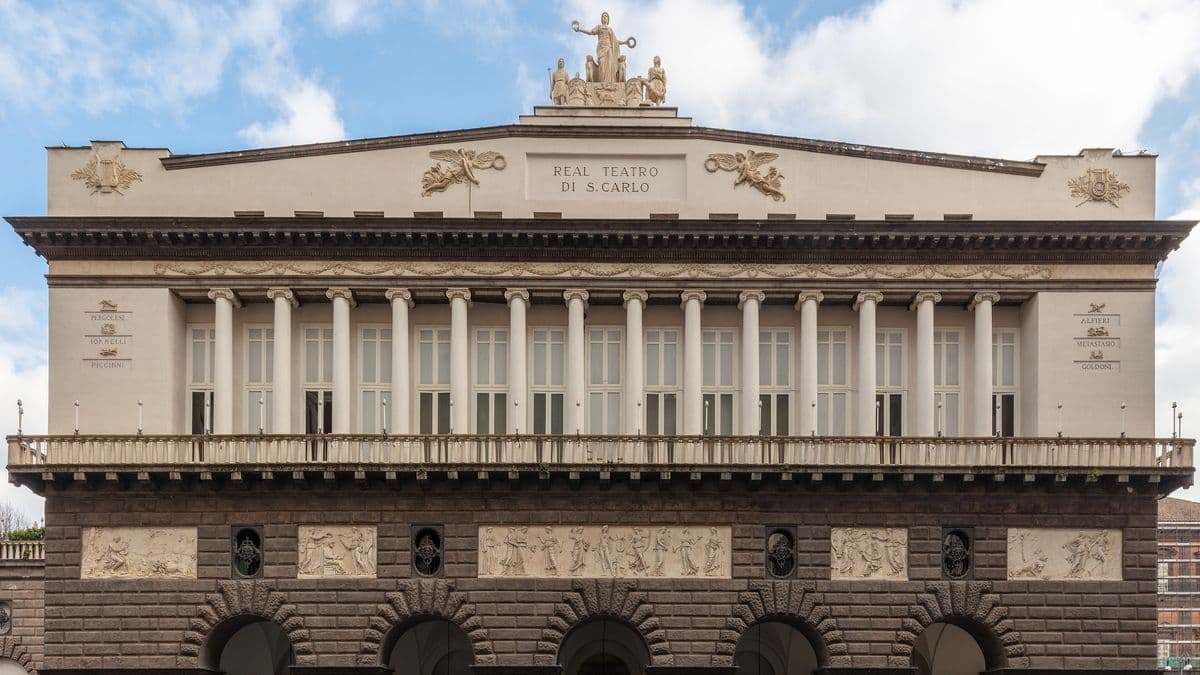
Verdi's Luisa Miller returns to the house it was written for when it opens the Teatro di San Carlo opera season on 2 December at 20:00, with further performances scheduled through 10 December.
Director Davide Livermore describes the opera as "un femminicidio allo stato puro", according to ANSA. The description is Livermore's interpretation of the drama, not an established classification of Verdi's work.
Livermore's staging reads the story through gendered violence and social confinement, according to ANSA. Luisa's physical disability is presented as a characteristic of the person rather than as spectacle.
Luisa is staged as paraplegic within an image inspired by Andrew Wyeth's "Christina's World", according to ANSA. The visual concept pairs a 1940s automobile with an American rural landscape shaped by Wyeth and Hopper-like references.
Livermore frames the opera as a family and bourgeois drama, according to ANSA. In that reading, social conventions, power intrigues and communal judgment contribute to the violence.
Daniel Oren conducts the Teatro di San Carlo Orchestra and Chorus, with Fabrizio Cassi as chorus master, according to the theatre and ANSA.
The principal cast includes Mariangela Sicilia and Aviva Fortunata as Luisa, Piotr Beczała and Stefan Pop as Rodolfo, George Petean and Franco Vassallo as Miller, and Michele Pertusi and Gabriele Sagona as Count Walter. The theatre presents the staging as a new production with a double cast.
Performances are sung in Italian with Italian and English surtitles, according to the Teatro di San Carlo. The theatre gives an approximate duration of two hours and 45 minutes.
The return carries a local history. Luisa Miller was composed by Giuseppe Verdi for the Teatro di San Carlo and premiered there in 1849, according to la Repubblica. The libretto was by Salvadore Cammarano, based on Schiller's "Kabale und Liebe".
The opera has a documented history of San Carlo revivals, including a 2015 production and performance cycle. That staging was conducted by Daniele Rustioni and directed by Andrea de Rosa, with the Teatro di San Carlo Orchestra and Chorus, according to Bachtrack.
The 2026 staging has not yet premiered, so audience and critical reception remain unresolved.