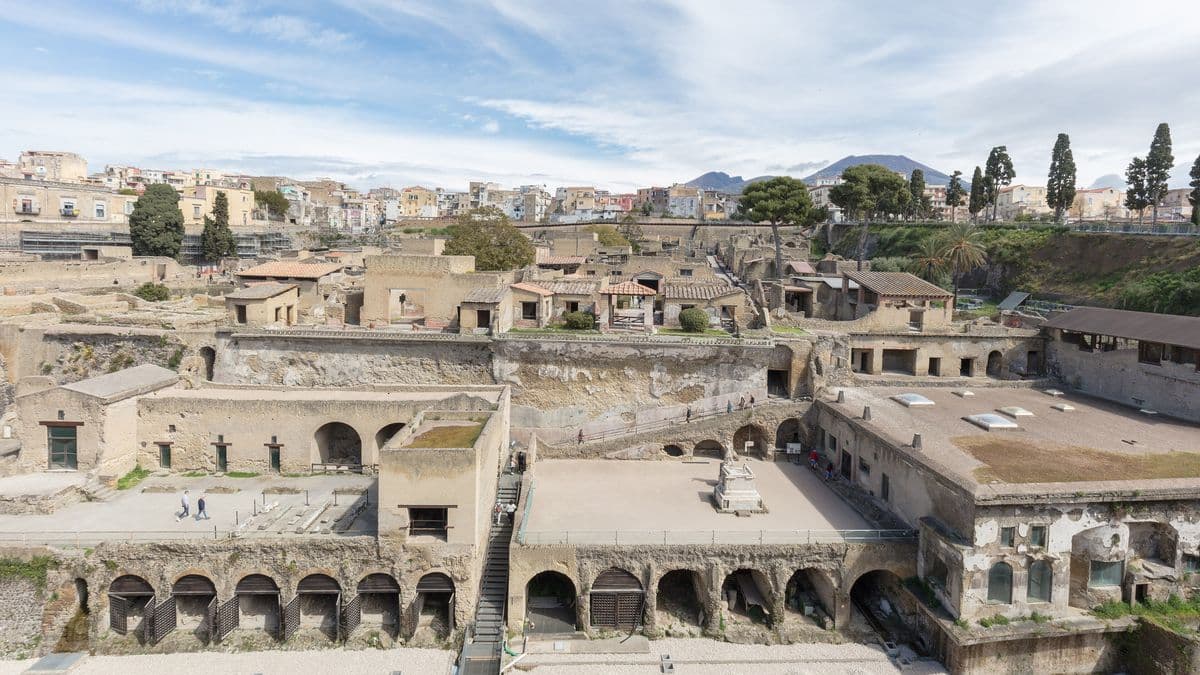
The Parco Archeologico di Ercolano has published an official remembrance of Antonio De Simone, describing him as an archaeologist and university professor and as a major scholar of Ercolano, Pompei, and the wider Vesuvian area.
The Herculaneum park presents his legacy as one of research, knowledge, and protection of archaeological heritage. That institutional framing is echoed by Pompeii Sites, which also issued a statement of condolence marking his work across Pompeii and Herculaneum.
Work at the Villa dei Papiri
At Ercolano, De Simone is particularly associated with the Villa dei Papiri.
According to the Parco Archeologico di Ercolano, his excavations at the villa brought previously unexplored sectors to light. The specialist archaeological account published by Naòs likewise records his work at the Villa dei Papiri and notes its contribution to understanding additional residential spaces.
The official Ercolano notice does not provide a full chronology of his academic appointments or excavations, so the remembrance focuses on the significance of that contribution rather than a complete excavation history.
Pompeii, Ercolano, and Somma Vesuviana
De Simone's research extended across Pompeii, Ercolano, and the Villa Augustea area of Somma Vesuviana.
Naòs identifies him as a professor of classical archaeology at Suor Orsola Benincasa and records research at Pollena Trocchia's Masseria De Carolis and Somma Vesuviana's Starza della Regina, within the framework of the Apolline Project. Pompeii Sites likewise describes his work on Pompeii, Herculaneum, the Villa dei Papiri, and the Villa Augustea of Somma Vesuviana.
The identification of the Somma Vesuviana complex as the place where Emperor Augustus died remains debated. Naòs reports that De Simone himself expressed doubts about that identification.
Monitoring work for conservation and planning at Pompeii
In his later years, De Simone coordinated archaeological monitoring activities intended to support the conservation and planning of Pompeii.
Pompeii Sites describes that final monitoring work as part of his broader commitment to connecting field research with the long-term care of the archaeological site. The Herculaneum remembrance places the same emphasis on protection of archaeological heritage alongside research and knowledge.
Why two archaeological parks marked his passing
For readers following the Vesuvian sites, one useful point in the validated research is that both major institutions spoke:
- The Parco Archeologico di Ercolano remembered De Simone for his contribution to Ercolano and the Villa dei Papiri, and for research, knowledge, and heritage protection.
- Pompeii Sites remembered his work at Pompeii and Herculaneum, the Villa dei Papiri, the Villa Augustea area, and his later archaeological monitoring work at Pompeii.
Together, those statements show a career that connected individual excavation projects with institutional conservation responsibilities.
Places associated with his research
A second useful guide from the sources is the list of places most directly associated with De Simone:
- Villa dei Papiri at Ercolano, where his work helped reveal previously unexplored sectors and residential spaces.
- Pompeii, including late-career archaeological monitoring work linked to conservation and planning.
- The Villa Augustea area of Somma Vesuviana.
- Masseria De Carolis at Pollena Trocchia and Starza della Regina at Somma Vesuviana, connected with the Apolline Project research in the area around Somma Vesuviana and Pollena Trocchia.
Visitors encountering those names in museum panels, site guides, or specialist publications are encountering parts of the same Vesuvian research landscape that the Ercolano and Pompeii remembrances describe.